Executive summary
Most firms have adopted some AI, but there is still huge untapped potential. Two-thirds report only "modest" returns, blocked by fragmented systems and poor data quality. The problem is not how intelligent the models are, or where they score on benchmarks. It is the architecture and the platform the model works within — and above all the ownership question many firms are beginning to face.
This paper makes five claims, developed in order:
- RIAs are uniquely positioned to win with AI. Revenue scales with assets, not hours — every reclaimed hour compounds into margin, capacity, or growth — and the industry's data already lives in a small set of known systems.
- The harness, not the model, is the differentiator. Intelligence should be rented per task, like a commodity. The operating system around it — memory, context, integrations, permissions, audit, compliance — should be built, and owned, by the firm.
- The way in is a digital twin, built at the edge. Nothing about the firm's current processes changes on day one; the twin normalizes data from the systems the firm already runs and lets AI work against it safely.
- The twin's core is an ontology — a real-world model of the business (objects, relationships, governed actions) that any employee, application, or AI model can speak. It is what grounds AI in the real business and lets it act safely, not just analyze.
- Compliance must be architectural, not bolted on. In an SEC-regulated business, post-processing is insufficient; obligations should be translated into engineering primitives beneath the AI itself.
This approach leads not just to increased efficiency, but to an asset that compounds. A firm that owns its ontology, its audit history, and its approval data can route ever-cheaper models at every task — and eventually adapt models on its own data — instead of forfeiting that leverage to a platform vendor.
The opportunity is concrete: industry research puts the administrative burden at 10–15 hours per advisor per week. We conservatively model roughly a third to a half of that as reclaimable — ~230–265 hours per advisor per year. But the hours are just the entry point. The bigger opportunity is the compounding asset the firm builds along the way.
1. Why RIAs
In short: revenue scales with assets, not hours — so every hour handed back to an advisor compounds into capacity, better service, or growth. Industry research pegs the administrative load at 10–15 hours per advisor per week. Few business models convert reclaimed time this cleanly.
The moment: four forces, one conclusion
Consolidation is accelerating. Roughly 77% of RIA assets now sit with about 7% of firms, and 2025 set records for M&A — on the order of 466 deals, up ~27% year-over-year, with private equity touching the large majority of transactions (Cerulli; Echelon Partners; DeVoe & Company). Sub-$1B firms increasingly face a scale disadvantage they must close operationally — or sell.
The talent pipeline can't keep up. The median advisor is about 51 years old; an estimated ~40% will retire within a decade, with roughly $10 trillion in client assets in motion (McKinsey; Cerulli). There aren't enough new advisors to backfill the work — which means the work itself has to get lighter.
Organic growth is thin. Stripped of market appreciation, organic growth for billion-dollar firms has run around 3.9% annually (Cerulli). With fee pressure persistent, productivity is among the most controllable growth levers a firm has.
AI has arrived — but underwhelmed. Most advisors now have an AI policy and use at least one AI feature, yet about two-thirds report only "modest" ROI, citing data quality and fragmented systems as the top barriers (industry surveys; Publicis Sapient). The tools work; the integration and trust are missing.
The structural advantages
Four things make an RIA better positioned for AI than almost any other professional-services business:
- Efficiency compounds for a fiduciary. An RIA charges a fee on assets — commonly blending to roughly 0.75%–1.0% of AUM — while compensation runs 50–60% of revenue (Kitces; InvestmentNews). Revenue scales with assets, not hours; paid time freed from administrative work flows almost directly to the bottom line, to capacity, or to growth.
- The data already lives in a few known places. A typical firm runs a recognizable stack: a CRM, a portfolio system fed by custodial data, a planning tool, and Microsoft 365. An RIA's operational reality can be normalized into a single coherent model — the prerequisite for AI that actually works. The number-one barrier firms cite is solvable by design.
- Human-in-the-loop fits the fiduciary duty. A fiduciary already reviews client-facing work before it goes out. An operating model where agents draft and humans approve isn't a safety compromise bolted on — it mirrors how good firms already work.
- The bar is low. Because most firms get little from point-solution AI, the competitive bar is not "use AI" — it's "use AI that is integrated, measured, and defensible." A firm that can show an examiner a complete audit trail, and show clients faster service, stands apart.
The prize, quantified
- 30–50% of advisor time goes to administrative, non-client work (Fidelity; Kitces).
- Advisors report on the order of 11 hours/week on manual tasks like note-taking and meeting prep (industry surveys).
- We conservatively model roughly a third to a half of the 10–15 hour weekly administrative burden as reclaimable: ~230–265 hours per advisor per year.
- Onboarding illustrates the prize: studies cite roughly 8 hours of manual labor per new client versus under 2 hours when automated, with faster onboarding linked to materially higher retention.
Reclaimed hours are where every AI conversation starts, but they should not be where it ends. The rest of this paper is about the bigger idea underneath them: who owns the system doing the work.
2. AI sovereignty: rent the model, own the harness
The first idea to internalize is the distinction between a model and a harness. Without a harness, an AI model is a set of generalized weights — a brain in a jar. The smartest intelligence in the world cannot accurately report on, analyze, or act on your business without the context, tools, and data that are specific to your business.
This is where the harness comes in. It gives the brain everything else it needs to operate inside an enterprise:
- Memory — short-term state and long-term canonical knowledge
- Enterprise system context — what your firm runs and how it fits together
- User context — who is asking, what their role permits
- Relevant documents and data — retrieved and packed into context
- Software integration and tools — reading from and acting on real systems
- A runtime environment — plan, act, observe, continue
- Permissions and governance guardrails — scoped to role and task
- Credential and key management — delegated, rotated, contained
- Audit trails — tamper-evident evidence of what happened
- Human-in-the-loop approvals — people where judgment belongs
- and, most importantly, industry-specific regulatory compliance
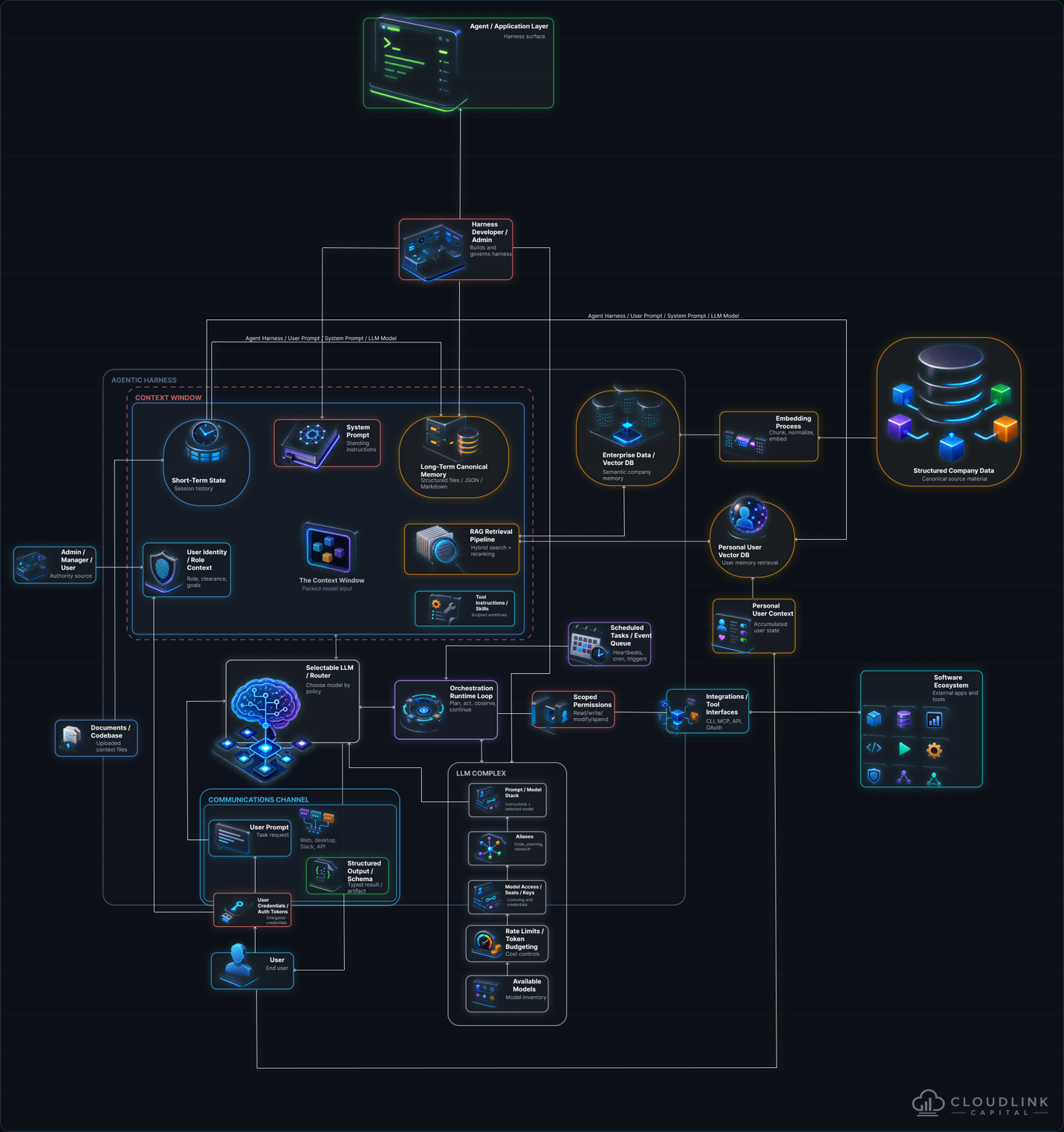
This is why a firm cannot simply download Claude Code or Codex, connect HubSpot and Microsoft 365, and expect to have an "enterprise solution." Those are superb generalized tools. The enterprise requires a specific operating system that is shaped like the business.
Any LLM can be plugged into a harness and swapped back out without disruption — the only question is how much reasoning power a given task requires. The harness cannot be swapped out. It is woven into the fabric of the business: its data, its permissions, its approval flows, its evidence. This creates a situation where the harness — not the model — is the bigger differentiating lever.
Who owns your operating system?
This brings us to build-vs-buy, and the ownership question underneath it: who owns your operating system and your data? As firms accumulate real experience with AI, the optimal strategy is getting clearer:
- Build (or have forward-deployed engineers build) the harness — the operating system over your data and systems — so the firm has 100% control over an asset optimized to its own business.
- Buy the LLM usage — per task, via API, like the commodity it is becoming — matched and tailored to each job being performed.
This gets the firm maximum efficacy, data sovereignty, and industry compliance — and critically, maximum flexibility in model routing. Many repeatable enterprise tasks do not require frontier intelligence. Armed with optimized context, smaller or open-weight models handle them day in and day out for a fraction of the cost — think orders of magnitude less per unit of work.
This is why forward-deployed engineers exist, and why firms like Palantir deploy them: not to hand out AI subscriptions to some employees and call it enterprise adoption, but to convert the business into an AI-native platform.
3. Becoming AI-native: a digital twin at the edge
Having worked with large, medium, and small businesses, there is an enterprise inertia that must be overcome for any platform change. This is the advantage of entrepreneurs and small business owners: they can build a solution before the enterprise can even have a meeting on it.
The only way an established firm keeps up is with an approach that draws from Clayton Christensen's Innovator's Dilemma: innovate at the edge, where the core business doesn't need to change. Concretely: a digital twin of the firm and its data layer, built by a dedicated team, beside the business — not inside it.
This works because it disrupts nothing. Emails still arrive in Microsoft 365. Contacts are still created in the CRM. But the data from all of these systems — AdvicePay, Calendly, DocuSign, eMoney, custodial file feeds from Fidelity and Schwab, Jump, Microsoft 365, Nitrogen, Orion, Smarsh, Wealthbox, Holistiplan, and the rest of the stack — is normalized and synced into an ontology layer that lets the entire firm's context and capability be leveraged by AI systems: first reading, then, with governance, reading and writing.
The firm keeps operating exactly as before. The twin becomes the surface on which AI works. And when the twin has earned trust — measured, workflow by workflow — the firm has become AI-native without a single big-bang migration.
4. The ontology: a digital twin that speaks your business
The core of the twin is an ontology — the operational semantic layer of the organization. (Palantir proves this pattern at industrial scale, and the concept maps remarkably well onto wealth management.)
Instead of forcing employees, AI models, or applications to interact with messy, siloed database tables and exports (tbl_cust_v2_final), the ontology translates raw data into a real-world, human-readable model of the business.
The building blocks
- Object types — the real-world entities, assets, and events. Generic examples: an Employee, a Flight, a Manufacturing Plant, a Support Ticket.
- Properties — the attributes that define an object. A Flight has a number, a departure time, a status.
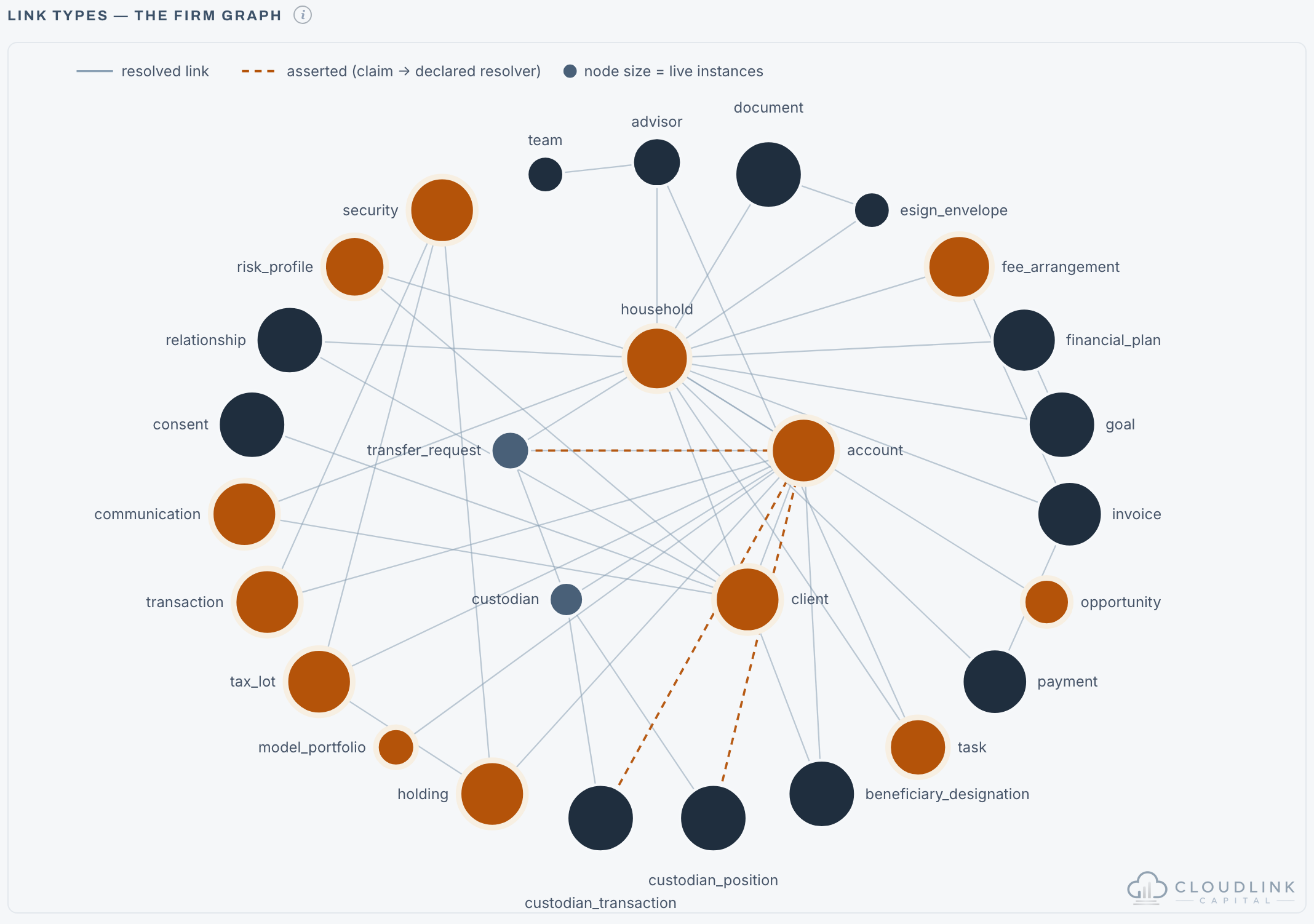
- Link types — the relationships connecting objects. An Employee is assigned to a Flight; a Part belongs to a Machine.
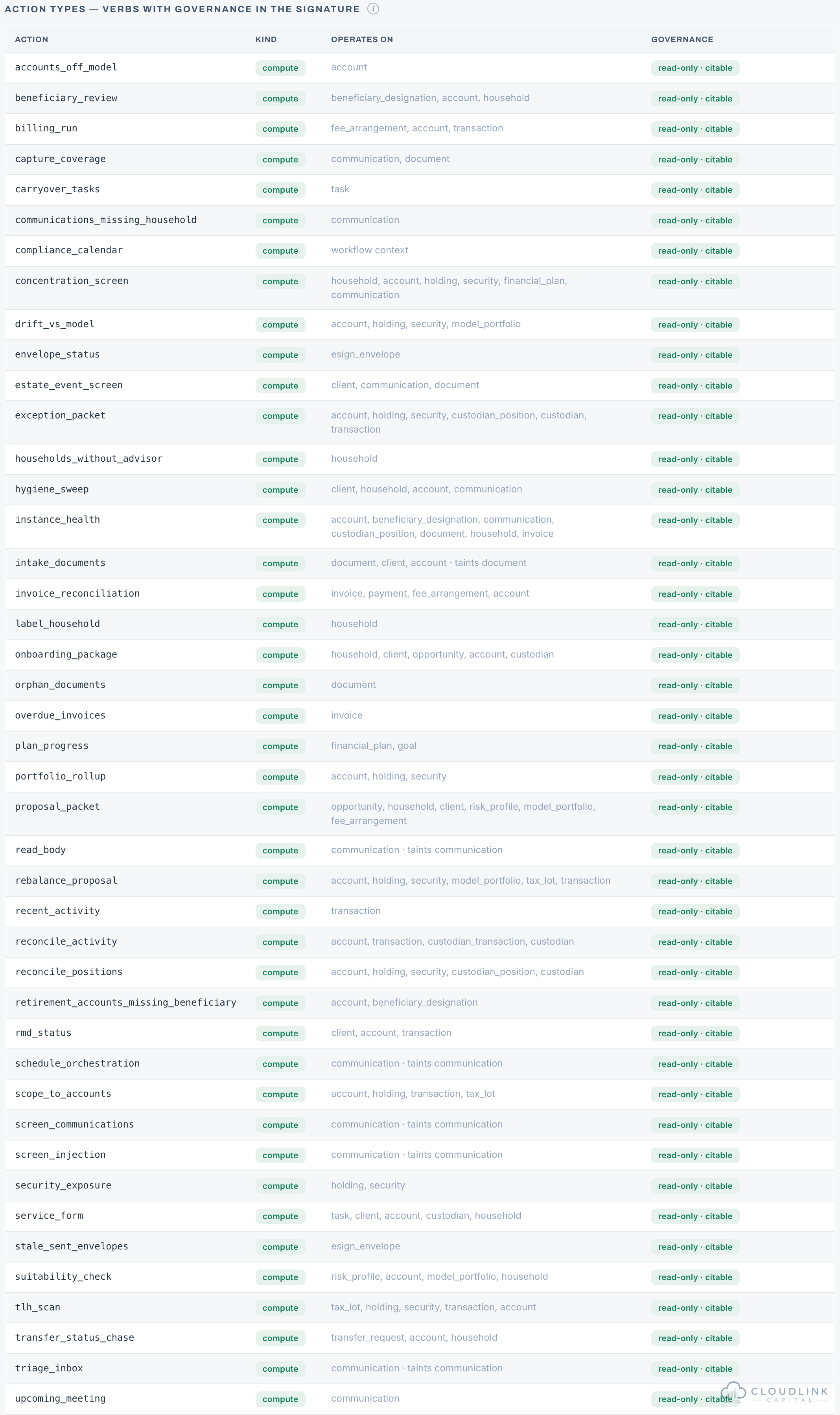
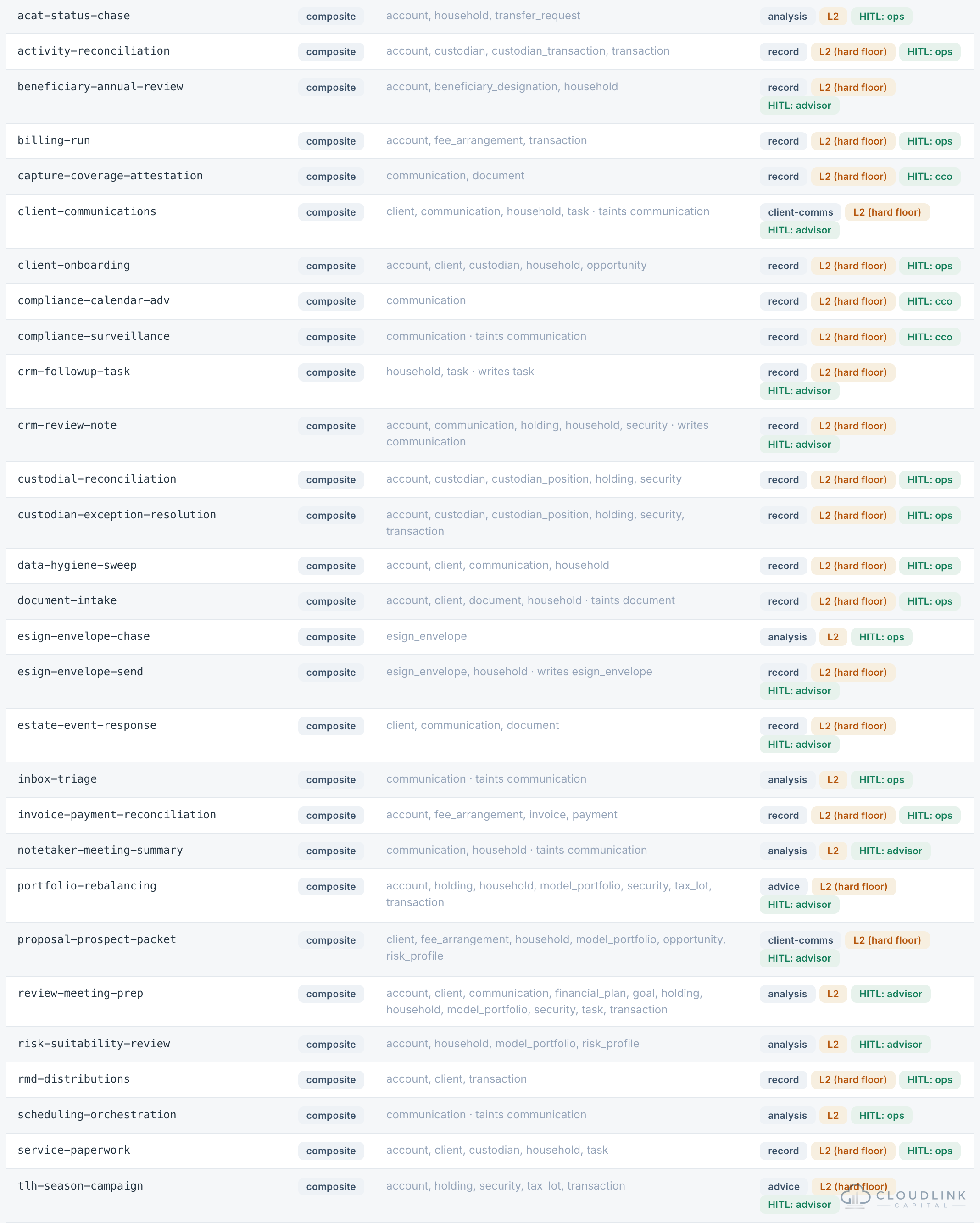
- Action types — the rules, business logic, and governed operations that let users or AI change objects. "Cancel Flight," "Reassign Crew," "Approve Purchase Order" — and when an action runs, it securely updates the underlying source systems.
Translate that into the RIA space and the mapping is direct — the focus shifts from supply chains and machinery to households, custodial workflows, and market risk:
| Component | RIA example | Properties / signature |
|---|---|---|
| Object type | Household | Total AUM, composite risk score, service tier |
| Object type | Custodial account | Account number, tax status (Roth, taxable), cash balance |
| Object type | Security | Ticker, asset class, 30-day yield |
| Link type | Manages / holds | Advisor manages Household, which owns Accounts, which hold Securities |
| Action type | Governed verbs | RebalanceToTarget(), FlagForCompliance(), ExecuteTaxLossHarvest() — each carrying its own governance |
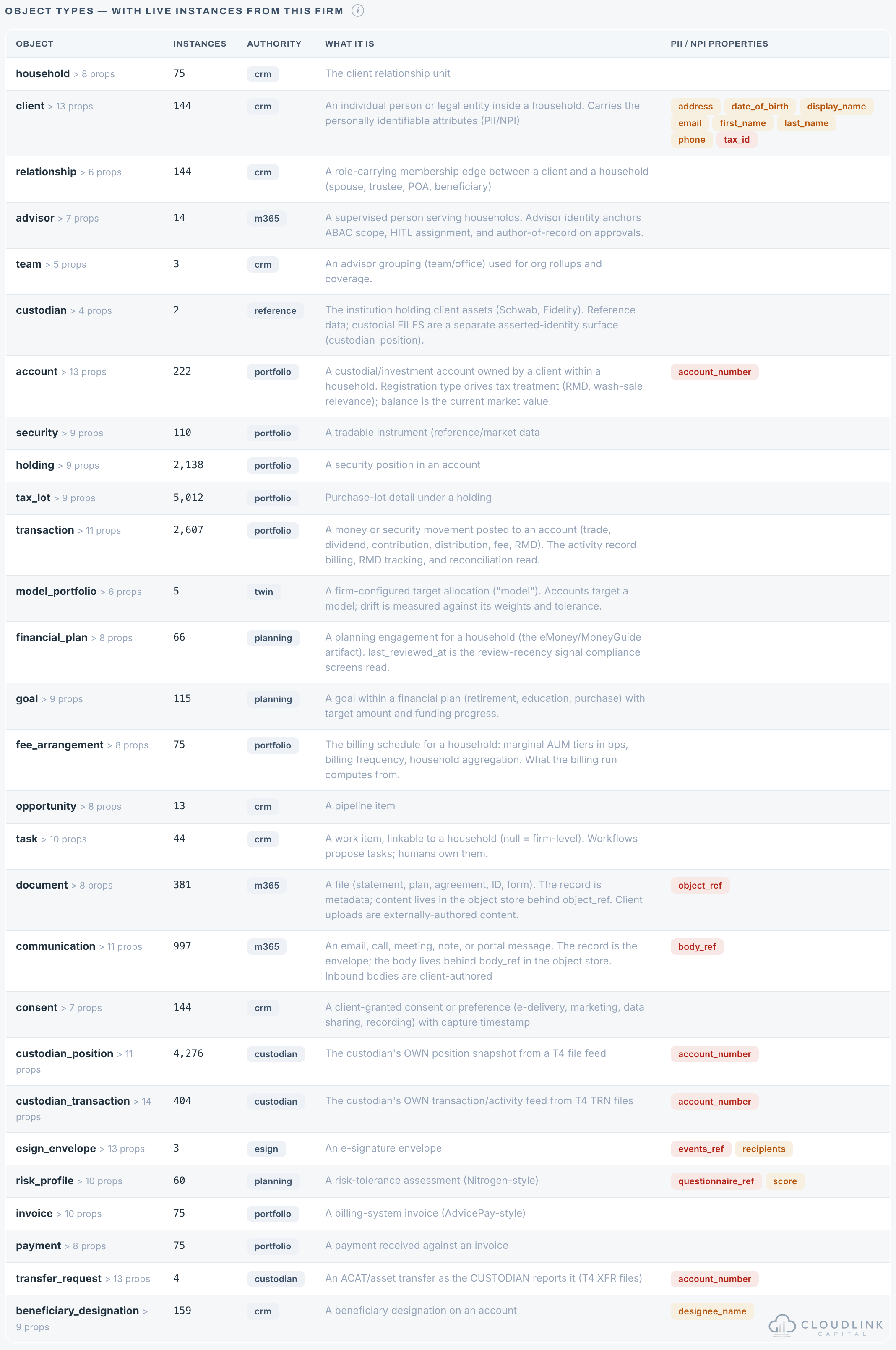
Here is what an RIA ontology looks like running against a live (simulated) firm — every object with its properties, its authority source, and its PII/NPI classification declared up front:
What the ontology changes
It provides a common language. Whether you are a data scientist, a client service associate, or the CEO, everyone looks at the same concepts. You no longer have four departments defining a "household" or an "active account" four conflicting ways across four dashboards.
It's built for action, not just analysis. Most data platforms are read-only: you see a problem on a dashboard, then log into a different legacy system to fix it. A good ontology is kinetic. When a user or a workflow triggers an action type, the platform safely writes the decision back to the source system — updating the digital twin and the real world together.
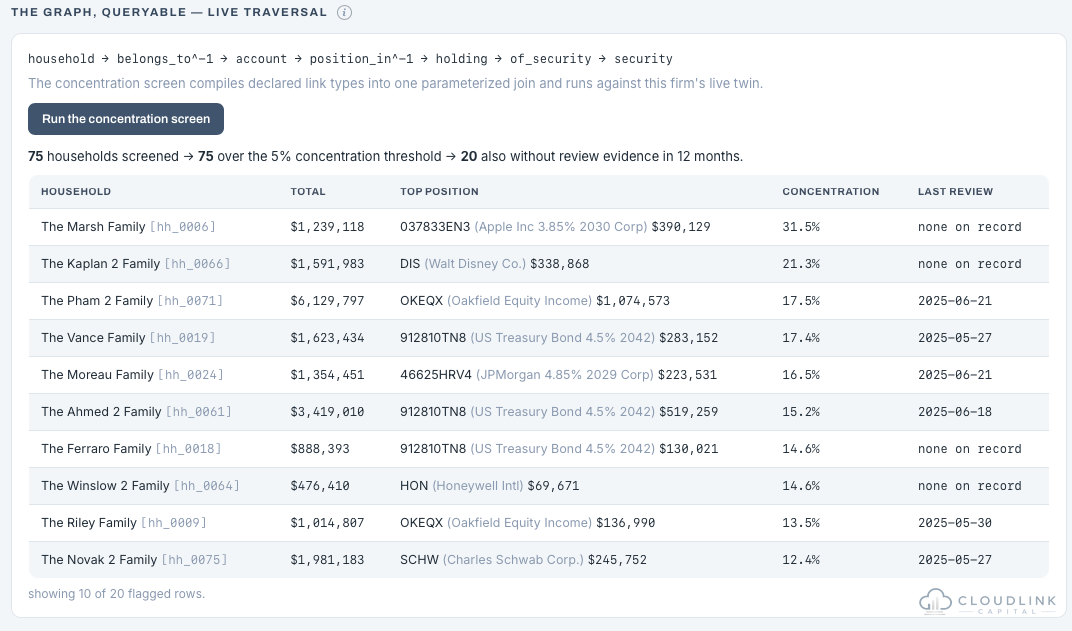
It serves as the grounding layer for AI. With LLMs, firms struggle with models hallucinating or misreading database schemas. The ontology is the guardrail and the context: when an AI agent is asked to work, it doesn't write blind SQL — it reads the defined objects, links, and actions, and it can only take legally and logically permitted business operations.
| Traditional data stack | Ontology |
|---|---|
| Manages data (rows, columns, tables) | Manages decisions (entities, relationships, actions) |
| Hard for non-technical users to query | Real-world language anyone can speak |
| Custom code for every new dashboard or app | Apps and AI models plug into the pre-mapped model |
And because actions are first-class objects, the entire catalog of what AI may do is inspectable — with governance in the signature, not in a wiki:
The patterns that matter to an RIA
Kinetic onboarding (bi-directional action). In traditional onboarding, an advisor collects data in the CRM, a client service associate re-types it into a custodial portal, then generates an e-signature envelope. With an active ontology this becomes a single action type: an associate triggers "Open custodial accounts" on the Household object; the system pulls the client details, pushes them via API to the custodian to generate the shell accounts, and dispatches the e-signature packet. No double data entry.
Git-style branching (planning scenarios). Instead of simulating market crashes for trading, you simulate life events for planning. An advisor branches a client's digital twin to model selling the business next year, or retiring early; the ontology projects tax impact and cash flow over twenty years. If the client adopts the plan, the branch merges and becomes the new baseline.
Dynamic network traversal (compliance surveillance). When a new SEC rule drops or a private fund changes its fee structure, compliance officers usually scramble through spreadsheets to figure out who is affected. With an ontology, graph traversal answers it instantly: Fund → Holdings → Custodial Accounts → Households — a real-time, filtered list of every affected household, ready for a bulk, governed response.
Security baked into the object (information barriers). If the Client object carries Social Security numbers or net worth, the ontology locks those properties by role. An intern building a marketing campaign sees anonymized tiers; the lead advisor and the CCO see the full picture. The protection travels with the data — dashboard, query, or AI tool alike.
The action layer (money movement). If a client requests a $50,000 wire for a house purchase, the workflow runs as a structured action, not a manual database update: verify identity (is verbal authorization or a dual-factor log linked to the household?) → check liquidity (is the cash there?) → stage the request (generate a service ticket routed toward the custodian) → require human sign-off (a named principal reviews and approves). Note what the action does not do: it does not move money. It stages, evidences, and routes to a human. Section 5 goes further — under the Custody Rule, an early deployment shouldn't just gate money movement; it should exclude it outright.

The agent harness on top
Put the harness of Section 2 over this ontology and the AI assistant becomes an operational co-pilot — strictly governed by the model of the firm:
- As a context map (meeting prep). An advisor asks, "Prep me for my meeting with the Smith family." The AI traverses the ontology: household data, the last three meeting notes, open service tickets (an unresolved address change), and a flag that the IPS hasn't been re-signed in two years. A clean brief, in seconds, with citations back to the objects.
- As a tool belt (post-meeting execution). "Update their risk tolerance to Moderate and start a task to consolidate the external 401(k)." The AI updates the CRM properties through governed actions and drafts the rollover paperwork for the service team to review. It executes administrative work. It does not place trades.
5. Governance built into the fabric
Why general-purpose AI fails in wealth management
In highly regulated spaces, AI adoption cannot outpace the firm's ability to govern it. And when regulated firms evaluate AI platforms, they quickly discover a fundamental flaw in most of the market: compliance is treated as a module bolted onto the architecture. General-purpose orchestration frameworks (LangChain is the best-known) are designed to maximize developer speed and agent autonomy; they approach compliance through post-processing — trying to catch errors, redact information, or log actions after the AI has already made decisions or touched sensitive data. Developer trace logs are built for debugging, not for evidence.
In an SEC-regulated environment governed by Reg S-P, the Marketing Rule, and Books-and-Records requirements, post-processing is insufficient. Regulators do not want a system that tries to be compliant. They expect a system that is structurally incapable of the violation.
For AI to be safely deployed at the core of an RIA, compliance must be architectural: take the most stringent SEC and FINRA obligations and translate them directly into low-level engineering primitives — below the AI agents themselves, into the ontology. What follows is the strategic thinking behind the core compliance design decisions I'm making at CloudLink, and equally, the questions any firm should put to any platform it evaluates.
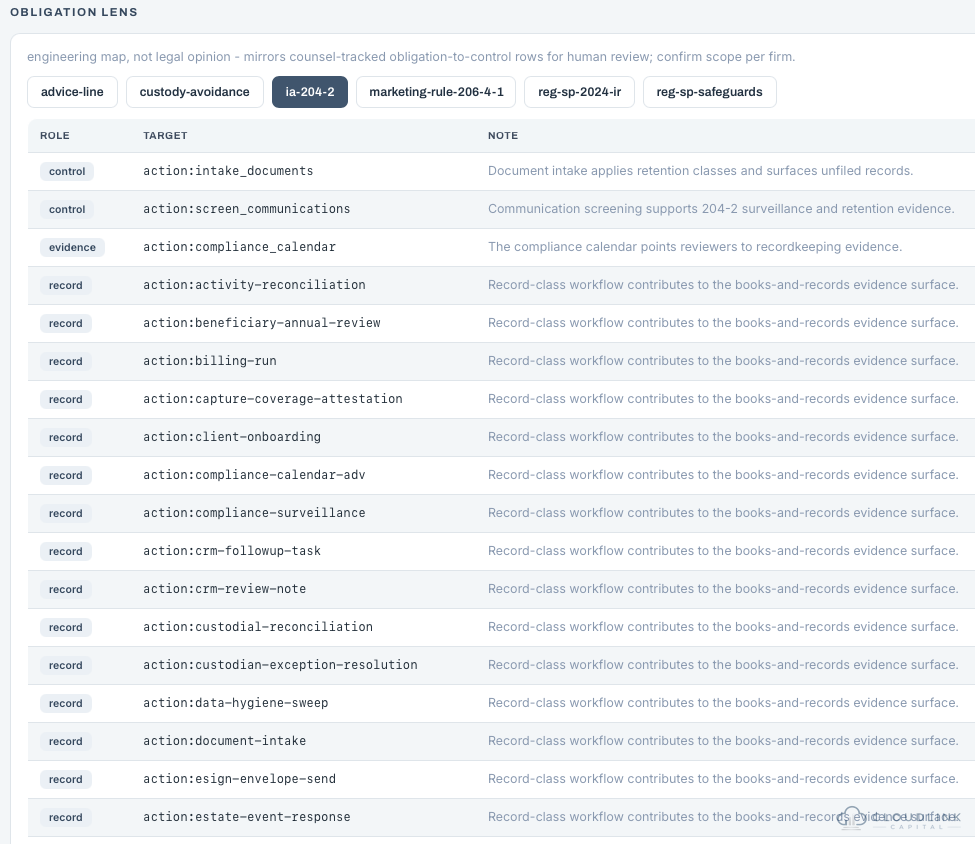
SEC Rule 204-2 (Books and Records): the immutable audit primitive
The challenge. Examiners require an accessible, tamper-evident record of advice, communications, and advertisements spanning years. Standard application logs and AI trace logs are mutable and carry no cryptographic proof.
The design decision. An immutable audit log as a core primitive — not application logging. Every consequential event — an agent proposing a portfolio adjustment, a human approving a client email, a change to a governance policy — is written to an append-only, hash-chained ledger under cryptographic signatures. Tamper with a record and the chain breaks. When an examiner requests the books, the firm produces a mathematically verifiable history of what the AI did and who approved it. And because the platform operates on a digital twin, the firm keeps a hybrid system-of-record posture: the twin derives its intelligence from the existing compliant CRM and portfolio systems, while the authoritative records stay safely where they are.
Reg S-P & GLBA: structural isolation and the non-escape gateway
The challenge. Safeguarding non-public personal information (NPI) is paramount, and the 2024 amendments to Reg S-P added tighter requirements: incident-response programs, service-provider oversight, and customer notification within 30 days. General-purpose AI stacks are notorious for data leakage and lack native boundaries.
The design decision. Address Reg S-P at three structural levels:
- Isolation by architecture. Reject pooled multi-tenant databases. Every firm operates in a structurally isolated environment — one database per firm — eliminating cross-tenant NPI bleed at the database level, not the policy level.
- The LLM gateway. AI agents never talk directly to language models. Every outbound inference request passes through a gateway that evaluates classification tags applied at ingestion and strips NPI before the payload ever reaches an external model.
- Complete data lineage. To meet a 30-day notification duty, a firm must know what data, whose, and where — instantly. A full lineage graph (origin → transformations → derivatives) turns breach-scope analysis from weeks into hours.
Rule 206(4)-1 (Marketing Rule) & fiduciary duty: human-bound execution
The challenge. The RIA is the fiduciary — not the software vendor. Machine output must never become advice rendered to a client without a human fiduciary in the loop, and client-facing communications must be fair, balanced, and substantiated.
The design decision. Draw a hard line in policy: autonomous mode is structurally forbidden for anything classified as advice or client communications. Agents generate proposals with their rationale. To authorize an action — sending an email, writing a CRM note — a human fiduciary reviews it, and approval isn't a mere button click: it mints a single-use, time-restricted cryptographic grant bound to the exact hash of the payload. The execution engine refuses to run without that proof. The AI does the heavy lifting; the human remains the author of record.
The Custody Rule: structural read-orientation
The challenge. Software that holds credentials capable of moving money can inadvertently pull the firm — and its vendor — into custody status, with the surprise-exam consequences that follow.
The design decision. Read-oriented by default, by architecture. No credentials capable of moving money. No payment initiation. No standing letters of authorization. Write-backs are limited to non-asset-moving operations — CRM notes, tasks, document envelopes — and every one is gated by the human-approval primitive. This is why the money-movement pattern in Section 4 stages and routes rather than executes: the right platform posture is to make the dangerous thing structurally unavailable, not merely discouraged.
A defensible posture
Translate regulatory obligations into engineering primitives and compliance stops being a bottleneck; it becomes a structural property of the platform. As the firm scales its use of AI, its regulatory posture scales with it — defensible, examiner-ready, and evidenced — because the controls an examiner tests are the same primitives the system runs on.
Nothing in this section is legal advice; see Important notices.
6. An asset that compounds
Owning an auditable, ontology-shaped data layer does more than make today's work efficient. It sets up continuous improvement — and eventually, model training — on terms the firm controls.
Use a standardized harness off the shelf from the big labs and you inherit two constraints: you are limited to the standard integrations, and your model selection narrows to a pre-determined menu. Meanwhile, open-weight models keep accelerating — as of this writing they are approaching parity with current-generation frontier models (think Opus 4.7/4.8, GPT 5.5) for a meaningful class of well-scoped tasks, at a fraction of the cost. The AI labs' revenue exploded in the first half of 2026 precisely because agents crossed the threshold of being genuinely useful for enterprise work; open weights are not far behind the frontier that crossed it.
"The future is composable models."
— Gavin Baker, All-In Podcast, June 2026
Our position agrees. The correct enterprise approach is compositional model selection: routing to the appropriately priced model per task — in ontology terms, per action. This is drastically more token-efficient, and it is not fully possible inside the labs' off-the-shelf platforms. Add the ontology's optimized context and the output quality of smaller models matches or approaches the frontier for those well-scoped tasks — at order-of-magnitude lower cost.
There is also one aspect of the frontier-model arrangement that runs exactly opposite to the enterprise's interest. Closed-weight labs improve their domain-specific products by accumulating data — including enterprise data — as they build verticals like legal, finance, and design assistants. Firms are waking up to the fact that they do not have to participate in that arrangement. A firm that owns a data layer mapping all of its context, actions, and history can adapt open-weight models on its own N=1 data — internally or through a service partner — and own the resulting weights. The result: a model whose tokens cost an order of magnitude less than frontier API calls, with the firm's business intelligence baked directly into the weights, that — combined with the ontology's context — performs at or near the frontier for the firm's own applications. And the freedom to plug frontier intelligence into the platform via API, inside the compliance envelope, never goes away for the tasks that genuinely demand it.
"The real opportunity is not in picking the best model but instead in building a learning loop on top of models where human capital and token capital compound."
— Satya Nadella, CEO of Microsoft, June 2026
That is precisely the architecture described in this paper. Human experts use AI to do their work; the traces, corrections, and approvals from that work feed back into the firm's own systems; the "token capital" gets smarter; the smarter it gets, the more powerful the humans become. Every approval queue doubles as a labeling operation the firm owns. The result is a continuous flywheel of institutional knowledge that the firm owns — not one it rents from a lab.
7. Where to start
The foundation of this whole thesis is the AI-native digital twin of your existing data, software, and context. It is the ultimate lever for everything AI will do in your firm — and the best first step is unglamorous: assess the current software and data landscape, and evaluate the API connections required to mirror it. Which systems hold the truth? Which expose it cleanly? Which will need partner-program admissions with real lead times? That inventory is the readiness assessment.
From there, sequence by trust earned, not by ambition:
- Quick wins — client communications and meeting notes, review-meeting prep, paperwork. Largest reclaimed hours, contained scope, fast proof.
- Operational backbone — onboarding and account opening, billing, RMDs. Deeper integration, higher stakes.
- Continuous and high-trust — compliance surveillance, portfolio rebalancing. Attempted after the platform has earned it, workflow by workflow, on measured evidence.
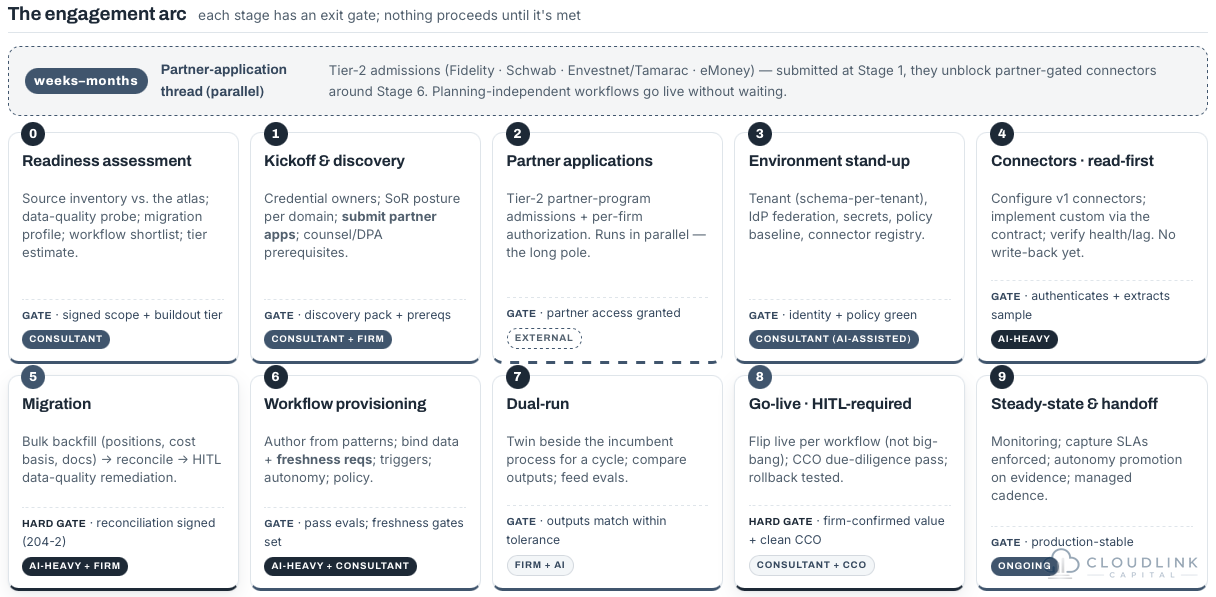
The twin runs beside the incumbent process until its outputs match; autonomy is promoted on evidence and revoked on regression; humans stay the authors of record throughout.
The reclaimed hours are the entry point. The owned platform — the harness, the ontology, the data — is the real asset. Firms that own that layer compound the advantage year after year. Firms that rent everything are building on someone else's platform, on someone else's terms.